
AI-augmented organization: where does your company stand?

Updated: Sep 7
From individual productivity gains to organizational reinvention, the organization now comes in several versions in light of AI.
You've probably come across these new terms: AI-Enabled, AI-Based, AI-First, AI Native, Agentic Organization, and sometimes, Symbiotic Enterprise . We'll explain these terms and their nuances. But more importantly, we'll show you why this is already an organizational reality and an HR challenge that is redefining work, teams, and workforce strategy.
At the helm of the AI-augmented organization
Artificial intelligence now extends far beyond individual productivity tools. For HR decision-makers, the real question is no longer whether to adopt AI, but how far the organization is willing to transform.
Most companies today are somewhere between the "AI-augmented organization" and "AI-based organization" stages, without a clear vision of the next level.
Organizations can be positioned on a continuum: AI-enabled → AI-based → AI-first → AI native → Agentic organization → Symbiotic enterprise.
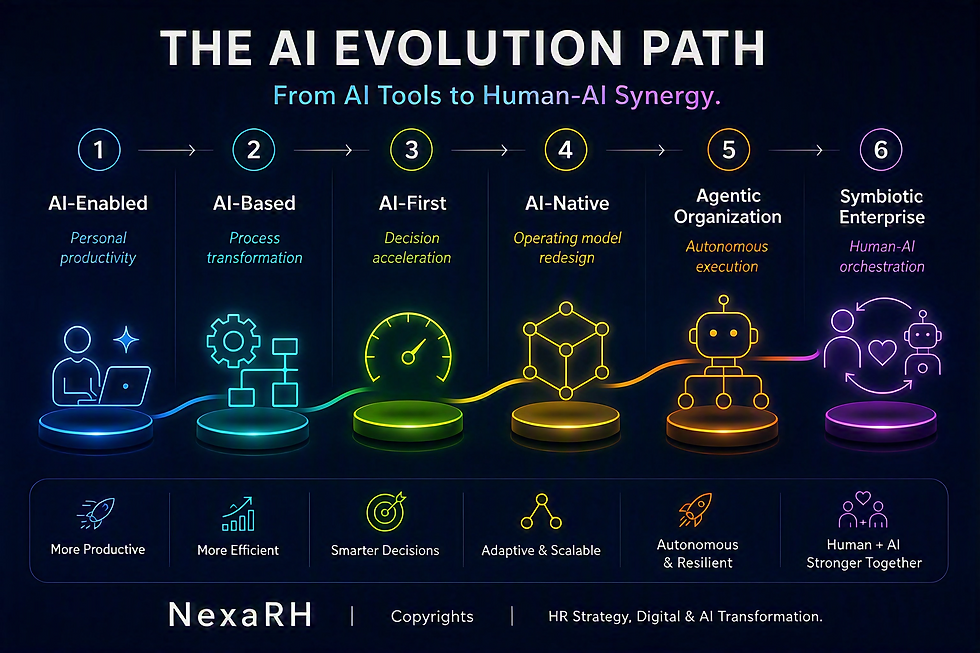
Knowing where your organization is located on this continuum becomes a strategic responsibility for CHROs and Chief People Officers (CPOs).
Stage 1: AI-enabled organization
An AI-enabled organization uses AI to improve existing tasks and workflows, without changing its operating model.
Examples include AI-assisted note-taking, content generation, candidate pre-screening assistants, and self-service chatbots for employees.
The goal is simple: to increase productivity, one task at a time.
Stage 2: AI-based organization
At the AI-based organization stage, AI is integrated into several business functions.
Talent acquisition, workforce planning, training, finance, customer service, and operations are all beginning to leverage AI-powered analytics. Organizations are moving beyond isolated pilot projects but remain primarily focused on improving existing processes.
The central question becomes: how can AI improve on what we are already doing?
Stage 3: AI-first Organization
An AI-First organization starts from a different question: how would we design this process if AI was available from the start?
Rather than automating activities after they have been designed, leaders are completely rethinking workflows.
Recruitment, integration, training, performance management and workforce planning are being redefined around AI capabilities, with human intervention reserved for judgment and relationships.
Stage 4: Becoming an AI-native Organization
AI-Native organizations build their business and operational models around AI from day one. These are primarily technology and digital services companies.
AI is no longer a supporting technology; it is becoming an integral part of the company's DNA. Roles, skills, governance, data architecture, and decision-making processes are designed with continuous collaboration between humans and intelligent systems in mind.
For HR managers, this means redefining workforce planning, career paths, leadership skills and organizational structures — a transition that NexaRH supports through its AI Roadmap in HR .
Stage 5: The Agentic Organization
The next stage is agentic organization, introducing AI agents capable of autonomously planning, coordinating, and executing a significant portion of the work .
Rather than simply assisting employees, AI agents become active contributors within workflows.
Given the complexity, the rapid pace of development by software vendors, and the costs of tokens and governance, the number of AI agents remains limited, but their potential is enormous. AI agents handle tasks or sets of tasks, and more rarely, entire jobs.
“ Agentic Organization is not about replacing people. It’s about combining tasks delegated to AI agents with work that has high human added value. As an occupational psychologist might observe, the future of performance lies in increasing the proportion of activities that require judgment, empathy, creativity, critical thinking, and human connection. ” — Jean-Baptiste Audrerie, co-founder of NexaRH and HR technology consultant
The challenge for HR is no longer the adoption of technology. It's the redesign of work itself.
Stage 6: The Symbiotic Enterprise
The most advanced organizations are going beyond automation to establish a true human-AI partnership.
In a Symbiotic Enterprise (a very futuristic vision outside of California and China, we grant you), humans and AI systems collaborate continuously, each bringing what it does best: technology takes care of scale, speed, pattern recognition and execution, while humans focus on purpose, ethics, relationships, leadership and innovation.
“ The goal isn’t to simply overlay AI technologies onto existing processes. The real value comes from rethinking processes in light of what AI makes possible today. Organizations that merely add tools will achieve marginal gains. Those that rethink their workflows will create transformational value. ” — Valérie Fichelle, co-founder of NexaRH and professional in organizational process optimization
From AI adoption to human-AI orchestration
The strategic question for CHROs
Most organizations today are still somewhere between the AI-Enabled and AI-Based stages.
Tomorrow's leaders will go beyond technology deployment to focus on organizational redesign. For CHROs, the challenge is not to become AI experts, but to become the architects of a new workforce and operations model where humans and AI create value together.
The organizations that will succeed will not be those that adopt the most AI tools. They will be those that rethink work, leadership, skills, and culture to thrive in an AI-driven future.
The question is no longer whether your organization uses AI. The question is: where are you on this journey, from AI-Enabled Organization to AI-Native, and what is your next level and why?
Artificial intelligence is no longer simply a productivity tool. As organizations progress along their AI journey, they go through distinct stages of maturity that transform how work is done, decisions are made, and value is created.
This evolution begins when employees use AI to increase their individual productivity, then progresses to organizations where AI is integrated into processes, influences decision-making, and becomes a foundational element of the operating model.
At the most advanced stages, autonomous AI agents execute and coordinate work alongside humans, ultimately leading to a Symbiotic Enterprise where human judgment, creativity, empathy, and strategic thinking are amplified by intelligent systems.
For CHROs and business leaders, this transformation is not just technological. It is an organizational overhaul that affects workforce strategy, leadership, management, governance, skills development, and the very nature of work.
Your next step: organize an AI Job Envisioning session at your next HR seminar
If you are a CHRO or human resources director and are wondering where to start, we suggest...
An AI Lab in HR (AI Envisioning) session offers your management team a structured half-day approach to compare your current job architecture with the AI transformation already underway, and leave with a clear list of priorities to address.
NexaRH works directly with HR managers and executives to implement, clean up and optimize job architecture, and align it with AI strategy and strategic workforce planning.
Contact us to arrange this session with your team, or discover our Job Architecture and AI-Era Job Diagnostic services to assess where your organization stands.
Also read : our article The dual mode of AI in HR: two new realities , and more analysis on our HR Tech, HRIS & HCM blog .
Key concepts
AI-Enabled Organization : a company that uses AI to improve existing tasks, without changing its operating model.
AI-Native : an organization whose business and operational model is designed around AI from the outset.
Agentic Organization : an organization where AI agents autonomously plan and execute a significant portion of the work.
Symbiotic Enterprise : a stage where humans and AI systems collaborate continuously, each contributing its distinct value.


Comments